

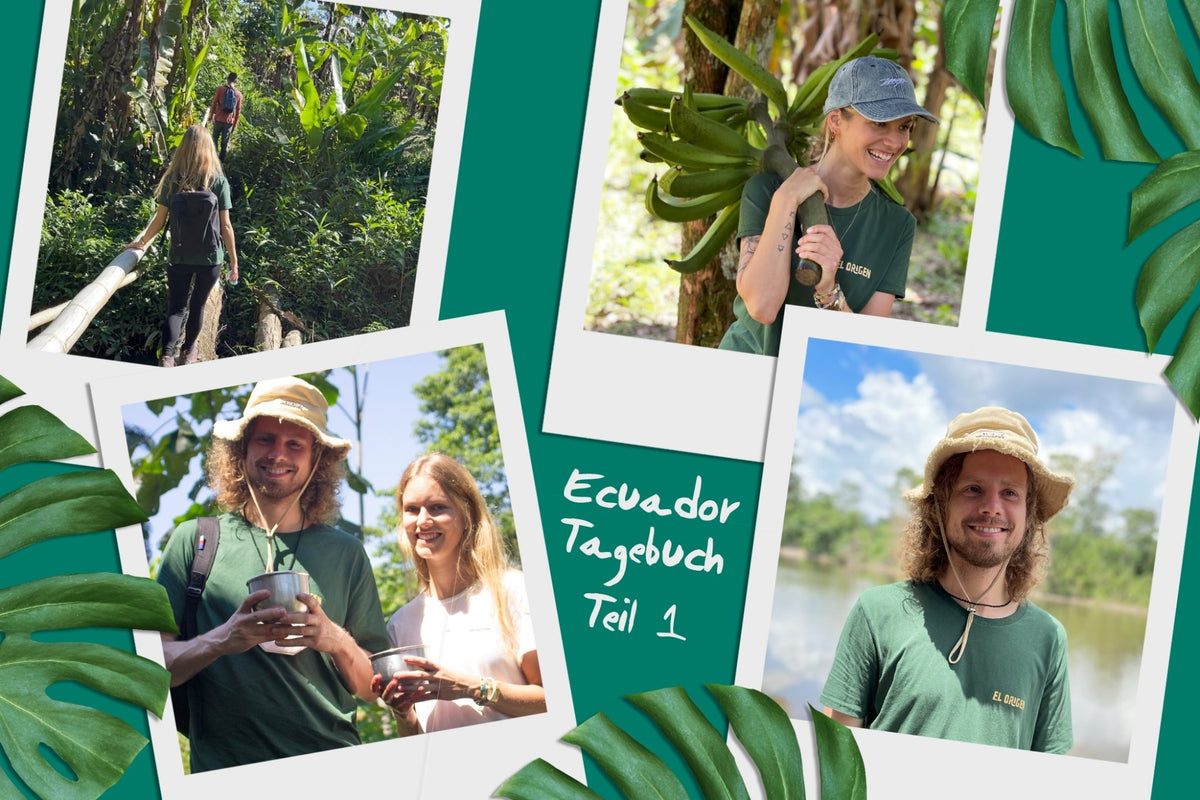
After almost two years and a global pandemic, it was finally possible for part of the el origen team to travel to Ecuador in October to visit not only our cooperatives and the production facility but also new partners for exciting new products.
Our dear Nele, Head of Supply Chain at el origen, has captured the highlights of the journey to the origin for you:
"Our founder Gordon and I started our journey after a long flight halfway around the globe to Ecuador's capital, Quito. After a short acclimatization and some sightseeing, we headed straight into the Amazon region to talk to the farmers of our cooperatives and learn more about the cultivation of organic cassava and plantains.
Arriving in Pucachigta in the "La Isla" region, we met farmer Alex and learned that the area was a beach just 20 years ago. In La Isla, due to the sandy soil, mainly yuca (cassava) is grown. Sandy soil is ideal for cassava cultivation. However, various other plant species can also be found on-site, such as plantains, fruit trees, papaya, guava, or avocado. The traditional cultivation system of the indigenous Kichwa communities is characterized by mixed cropping. The Kichwa call this "Sistema Chakra," meaning everything grows together and in harmony here.
During a short break, we also got to "enjoy" Chicha for the first time. Chicha is a type of cassava beer, which is considered a staple food in the Andean region of Latin America because it is very filling. At the same time, Chicha is often served as a welcome drink. Chicha is fermented by saliva and is therefore sometimes affectionately called "spit beer." 😳 The cassava root is cooked until soft and then mashed before parts of the mass are chewed and returned to the pot. Then water is added, while the cassava mass is squeezed and sieved by hand. Finally, the drink is left to ferment for at least one day. Sounds delicious, right? 🥴
Well, we had to go through with it, because it's considered very impolite to refuse Chicha as a gift. And since we not only visited farmer Alex and his family but also other cooperatives, you can imagine that we got to indulge in much more than one round of Chicha... Did we mention that Chicha also contains quite a bit of alcohol?
Another stop on the Amazon journey took us to Imelda's (66) organic plantain plantation. Imelda not only grows organic plantains herself but is also the coordinator for the Wiñak cooperative's farmers on the island of "Ahuano" and, among other things, ensures fair payment distribution.We were welcomed very openly and warmly, and it was very interesting to learn everything about the fields and cultivation firsthand. It was also interesting that the fields are divided into different plots and managed by an entire family. In the Kichwa community, it is a tradition for parents to allocate land to their children for planting, and this is passed down through generations. Imelda also explained to us that the plantain plantations in the region are plagued by strong winds, and the farmers therefore lose up to 20% of their harvest. Therefore, a fair price per kilo is all the more important for the cooperative's survival so that families can continue to make a good living from it. Learning about the everyday challenges personally on-site was very insightful for us. It showed us even more how significant our direct cooperation with partners in Ecuador is."
Do you want to know how the adventurous journey continues? Part 2 of the journey follows. Stay tuned!


