

Latin America is one of the most diverse regions on Earth and is home to incredible biodiversity! Unfortunately, the valuable Amazon region in Latin America is particularly threatened, and social injustices are still common.
We care deeply about Latin America, which is why we want to make a difference and support its nature and people. To do this, we source our products through Direct Trade. This means that our producer of organic plantain and organic cassava chips obtains raw materials directly from farmers, without any middlemen who would take a portion of the sales from the farmers.
Through Direct Trade Standards, we commit to long-term partnerships and higher incomes – thereby sustainably improving the living standards of local farmers and their families.
Our farmers have formed cooperatives so that they can continue to own and cultivate their land themselves, instead of leasing it expensively from large corporations. Furthermore, by joining forces, they have more opportunities for joint investments and easier access to necessary services. The cooperatives also specifically create jobs for women, and there is no difference in wages between men and women.
The cooperatives that supply us and our producers in Ecuador with organic plantains and organic cassava have almost 1,000 hectares of cultivated land in several provinces of Ecuador.
These 1,000 hectares belong to a total of 314 indigenous families who are members of the Wiñak and Unocace cooperatives.
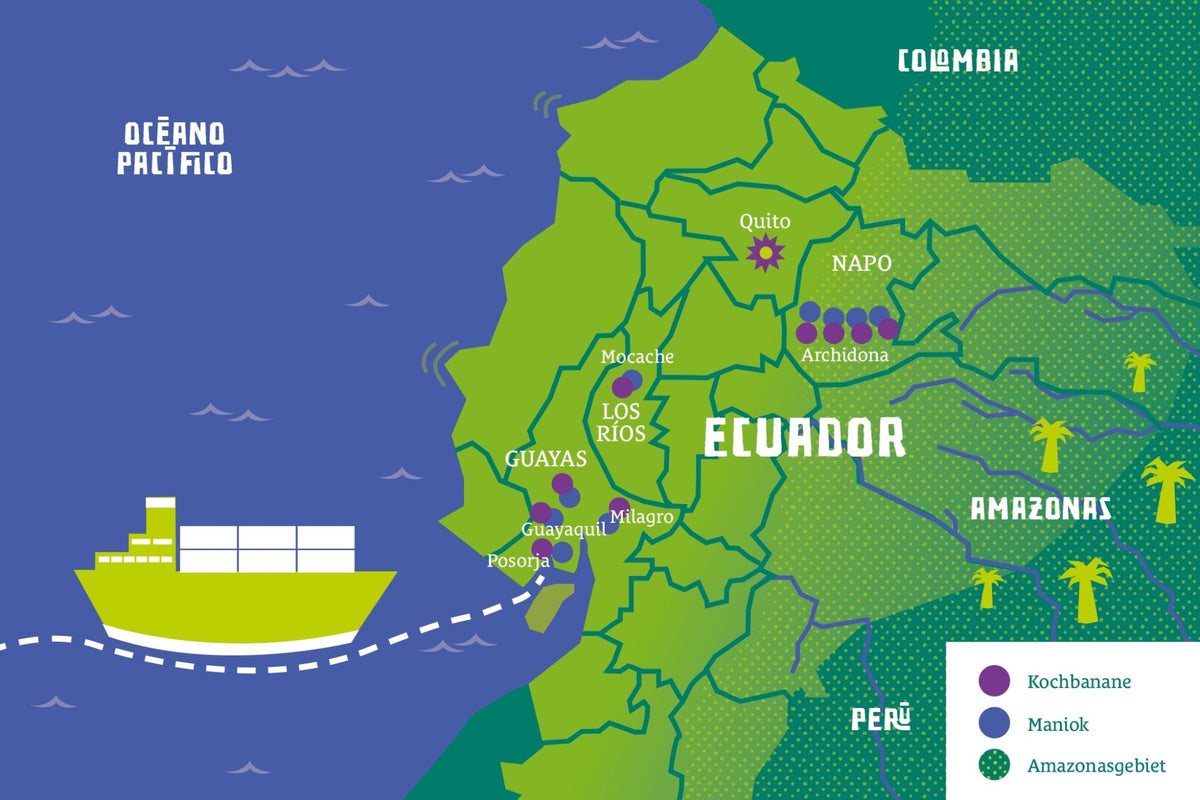
Due to similar climatic conditions, plantains and cassava are found in two regions of Ecuador: on the coast in the west and in the Amazon region in the east. The Unocace cooperatives are located in the coastal region. The approximately 20 indigenous communities of the "Kichwas," which form the Wiñak cooperative, are distributed throughout the Amazon region.
The cultivation of our raw materials therefore takes place in Archidona (Napo Province), Guayaquil and Milagro (Guayas Province), and Mocache (Los Rios Province).
And finally, a little fun fact: On the west coast, bananas are thinner in summer due to less rainfall than in winter. However, since there is no summer or winter in the Amazon region in the east and the climate is consistently the same throughout the year, the bananas in the east are slightly thicker year-round. Did you know that?


